
Aug. 19, 2026: Wildfire Smoke Air Quality Update
Posted on August 19, 2026

The current air quality across Missoula County is Moderate. See current air quality conditions at Fire.AirNow.Gov.
Warmer temperatures and gusty winds increased fire activity at regional fires yesterday, resulting in worsening air quality conditions. Last night, a couple of air quality sensors in Missoula County reached Unhealthy for Sensitive Groups but most are at Moderate this morning.
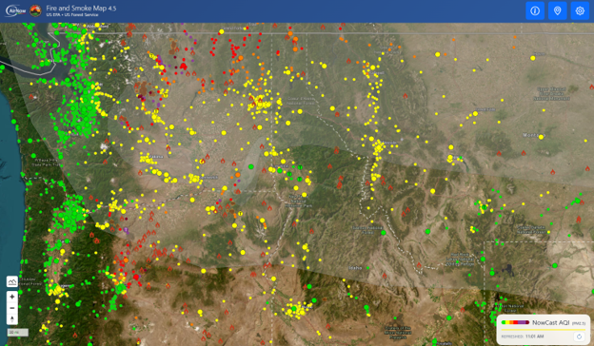
Air quality conditions from EPA Fire and Smoke map on Wednesday, Aug. 19.
Hot, dry, and windy conditions are forecast to continue through Friday as high pressure builds over the region. Fire activity and smoke production will likely continue to increase across the region. West winds will blow smoke in from nearby fires in Idaho like the Moose Mountain, Grotto, and Cascade fires, and from other fires further away in Oregon, Washington, and British Columbia. The Cherry Peak Fire that started yesterday near Thompson Falls in Montana could also send smoke our way.
Expect worsened air quality overnight as smoke settles into the valleys and improvements throughout the day as increased dispersion helps the smoke lift and mix out of the valleys. Cooler temperatures, increased winds, and potentially more thunderstorms are forecast for this weekend.
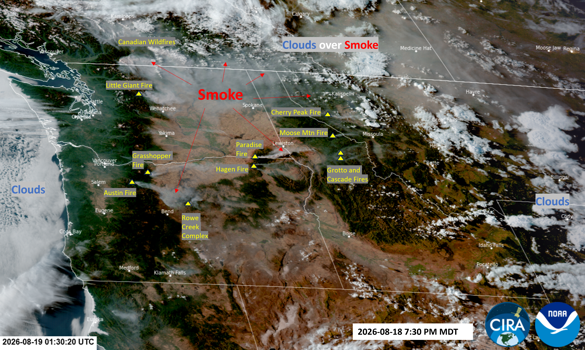
GOES West satellite imagery from 7:30 p.m., Tuesday, Aug. 18 .
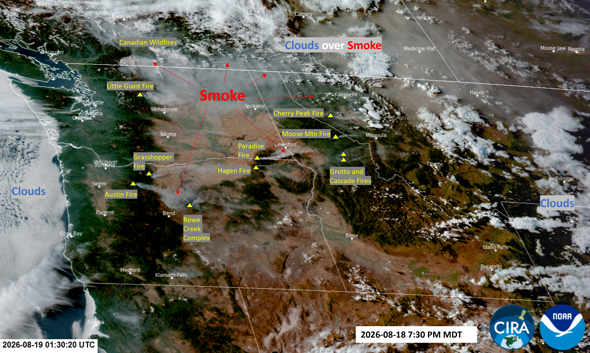
GOES West satellite imagery from 8:30 a.m., Wednesday, Aug. 18 .
When the air quality is Moderate or Yellow on the Air Quality Index, unusually sensitive people should consider making outdoor activities shorter and less intense. Watch for symptoms such as coughing or shortness of breath. These are signs to take it easier. If you aren't sensitive to particle pollution, it's still a good time to be active outside.
When air quality is Unhealthy for Sensitive Groups (USG) or Orange, sensitive groups should limit their exposure to the smoke/PM2.5 in the air. But in reality, smoke affects everyone and even if you’re not considered a sensitive group, you may still feel those health impacts when it’s USG. The term Sensitive Groups is a catch-all for those likely to have a higher sensitivity to air pollution. It includes but isn’t limited to people with heart or lung disease, older adults (65+), children under the age of 18 (especially younger children), pregnant persons, people with preexisting conditions or chronic illnesses, outdoor workers, and people living outdoors.
Here’s how you can reduce your exposure throughout your day:
- Go to a place with clean indoor air or create one at home/work
- Reduce duration and intensity of outdoor activity, especially strenuous activity
- Wear a well-fitted N95 or KN95 mask (great for chill outdoor activities like walking, watering your garden, mowing, etc.)
- Run vehicle A/C on recirculate instead of pulling smoky outside air into the car
For more information about ways to keep smoke out of your living space and reduce your exposure to smoke, explore the resources at MontanaWildfireSmoke.org.
Remember that air quality can change rapidly, so it’s always a good idea to check the latest air quality conditions at Fire.AirNow.Gov. If conditions are changing fast, take a look at the Hourly PM2.5 and Sub-Hourly graphs to get the latest data from each sensor.